Open government in Raleigh and BarCampRDU
Sunday, 19 May, 2013 — civics barcamprdu conference
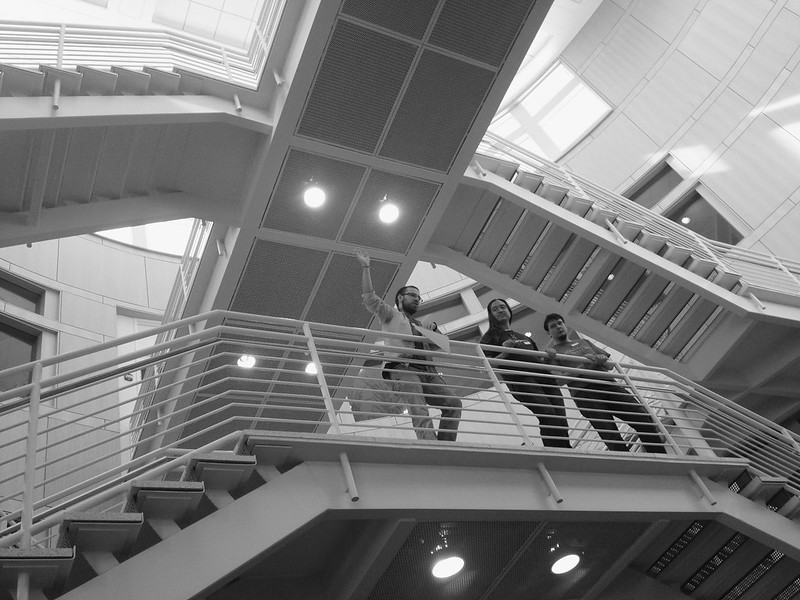
Above: Cristóbal Palmer, Justis Peters and Dan Sterling open BarCampRDU 2013
May 18, 2013 marked the return of BarCampRDU after an 18-month absence. There were five session slots followed by lightning talks. All the sessions I attended were in some way interesting (see below for a list), but I want to start by focusing on one by Jason Hibbets, “Open Source All the Cities!”.
Overall, I was impressed at Hibbets’ passion for civic involvement. I was also pleasantly surprised by the number of Open Data/Open Government initiatives already in-progress in Raleigh. It’s something I’ve had a desire to see and participate in, but did not know was thriving. In particular, I’ll be making use of SeeClickFix to request some traffic calming in my neighborhood. I also want to have a look through Raleigh’s open data portal to see what I can pull out and futz with.
For as much as government is complained about, a lot of time, it’s just “there” for a lot of folks. I don’t know if there was ever a golden age of civic involvement, but I hypothesize that we have better neighborhoods and cities if we learn more about how to affect change in our neighborhood and follow-up on it. What I mean by that is making sure problems with infrastructure are reported, instead of assuming someone in Public Works knows. It means asking for sidewalks, crosswalks and traffic calming to help neighborhoods more walkable. It means reporting problem properties, starting a neighborhood watch, having a block party, cleaning a neighborhood creek or just clearing the storm drains down the block.
These aren’t partisan issues. Think of civics as a sense of stewardship for what’s around you. I am a steward, my neighbors are stewards, if they choose to be, city government is a stewardship, too, and one that I can influence. You can, too.
My raw notes for Jason’s talk:
- Explaining open source to a non-technical/unfamiliar audience
- Open source is like a recipe
- Ingredients
- Process
- Open source is like a recipe
- Principles
- Transparency
- Code
- Roadmaps
- Bug reports
- Creates accountability
- Collaboration
- Hierarchy vs. peer-to-peer
- Foster innovative ideas
- Rapid prototyping
- Release early, release often
- Fail faster
- Meritocracy
- Best ideas rise to the top
- Best code tends to win
- Best ideas rise to the top
- Passion
- Projects exist because people are trying to scratch their own itch
- Transparency
- Open source as a philosophy past software engineering
- opensource.com is where discussion happens about things that can have open source principles applied to other areas
- Civics beyond government
- Opening up a channel back to government
- Creating a community
- Elements of a open source city
- Culture/participation
- Open government and data policies
- Catalyst: CityCamp Raleigh
- 200 people each of the last two years
- Triangle Wiki
- Had a Triangle Wiki Day
- 50 people showed up including city council members, mayor
- Had a Triangle Wiki Day
- RGreenway team built the RGreenway mobile app
- iPhone
- Android
- Goal is to do something after the Camp
- CityShape – Mayor’s Challenge
- “Where should we put more density?”
- SeeClickFix
- Bug tracking for city infrastructure
- Potholes
- Tree branches
- Graffiti
- During Hurricane Sandy, people used the tool to organize + source help
- Bonner Gaylord
- Open Gov advocate and city councilman
- Piloted in his district and city council ended up adopting
- Goal is to break down political boundary barriers (e.g. Raleigh and Cary)
- You can set-up watch areas to see when other people submit items in your area
- City council, mayor and local media all get pinged when an item gets submitted
- Bug tracking for city infrastructure
- Open government resolution
- City of Raleigh will consider open source software
- Established an open data portal
- City put $50,000 and hired an open data manager toward that initiative
- Open Raleigh website
- Data Portal
- Code for America
- Peace Corps for Geeks
- Built “Adopt a Fire Hydrant” for Boston
- Other “Adopta” solutions
- Sidewalks in Chicago
- Bus stops in Raleigh
- Storm drains in Seattle
- Tsunami Sirens in Honolulu
- Brigade program
- Code for Raleigh
- Active
- Participated in “Race for Reuse”
- We already have applications that are good, how can we increase their adoption?
- Cary just adopted a brigade
- Durham is close to having one
- Proposed: Triangle Code for America Division
- Get multiple brigades together to share expertise
- Code for Raleigh
- He wrote a book, The Foundation for an Open Source City
- Used IndieGoGo to fund
- Get involved!
- Events
- CityCamp NC
- May 30-31, 2013
- Hunt Library, NC State University Centennial Campus
- National Day of Civic Hacking - June 1
- Office hours with Code for Raleigh at HUB Raleigh on Hillsborough
- CityCamp NC
- Join Code for Raleigh
- Events
Other sessions
The other sessions I attended were:
- Organizing Tech. Conferences
- BarCampRDU 2013 organizer Jeremy Davis led a retrospective on the organization of BarCampRDU 2013 and the elements that make a technical conference successful
- Worth a post on its own
- Git Internals
- Jimmy Thrasher did a nice whiteboard session of how Git does what it does
- Getting Kanban-odoros Done!
- Chris Imershein led a session talking high level about
- Getting Things Done
- Personal Kanban
- The Pomodoro Technique
- Chris Imershein led a session talking high level about
- Pebble API
- Cristóbal Palmer led a session on building apps for the Pebble watch
- Lightning Talks
- There were several, but two in particular I liked.
- Justis Peters talking about several Coursera courses he is taken or has taken around machine learning and neuroscience
- A talk on the value of full-spectrum lighting (if someone can tell me the name of the woman who presented that, I would love to update the post accordingly)
- There were several, but two in particular I liked.
Event photos
I took a few. Check out the set I put together over on Flickr.
Thank you
The BarCampRDU 2013 organizing group and volunteers did a fantastic job with the event. Thank you, all, for your efforts in rebooting the event. Having BarCampRDU back is great for the local community. Thank you, too, sponsors.
I’m looking forward to BarCampRDU 2014.